
Trade Card for Whiting & Branston, Engravers & Printers
19th century
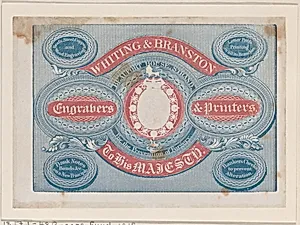
Medium
Engraving with embossment
Dimensions
Sheet: 4 1/8 × 5 9/16 in. (10.4 × 14.1 cm)
Classification
Prints|Ephemera
Department
Drawings and Prints
Museum
Metropolitan Museum of Art, New York, NY
Credit
Rogers Fund, 1918
Accession Number
18.17.1-48
Rights
Public Domain
Art Historical Context
Step into the vibrant world of 19th British commerce with this charming *Trade Card for Whiting & Branston Engravers & Printers Created anonymously during the height of the Industrial Revolution, petite engraving (just 4 1/8 × 5 9/16 inches) served as a promotional tool for the firm itself, advertising their expertise in high-quality printing and engraving. Trade cards like this were ubiquitous in Victorian Britain, distributed by businesses to customers and collectors, blending artistry with everyday marketing in an era when printed ephemera became a cultural phenomenon. The medium—engraving combined with embossment—highlights the technical prowess of Whiting & Branston. Engraving involves incising designs into a metal plate for precise, intricate lines, while embossment adds a luxurious raised texture, making the card not just seen but felt. This tactile innovation elevated simple business cards into collectible objects, showcasing the firm's mastery and the era's advances in print technology. Housed in the Metropolitan Museum of Art's Drawings and Prints department (acquired via the Rogers Fund in 1918), this piece offers a window into how graphic design bridged art and industry. It reminds us that even "disposable" ephemera captured the elegance of 19th-century craftsmanship, preserving a slice of entrepreneurial history for today's visitors.
About the Artist
Anonymous, British, 19th century · 1800–1900
**Anonymous, British, 19th century** is not the name of a single individual but a standard museum attribution used for works whose creators remain unidentified yet are clearly British and date to the 1800s. Major institutions, including the Metropolitan Museum of Art, employ this designation for hundreds of drawings, prints, designs, and decorative studies that lack signatures or firm documentary ...