
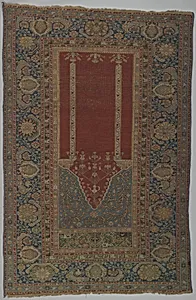
Transylvanian prayer rug
Unknown Artist
early 18th century
Medium
Wool pile on wool foundation.
Dimensions
Length: 2 m. Width: 1.3 m.
Classification
Textiles-Rugs
Culture
Turkish, possibly Kula region
Department
Robert Lehman Collection
Museum
Metropolitan Museum of Art, New York, NY
Credit
Robert Lehman Collection, 1975 1975.1.2454
Accession Number
1975.1.2454
Rights
Public Domain
Art Historical Context
This exquisite Transylvanian prayer, woven in the early 18th, exemplifies the masterful artistry of Ottoman Turkish textile traditions, likely from the Kula region inolia. Measuring 2 meters in length and 1.3 meters in width, it features a wool pile knotted a wool foundation—a durable technique using symmetrical Turkish knots that allowed for intricate patterns and vibrant dyes derived from natural sources like madder and indigo. The rug's mihrab arch, a of prayer carpets, would have oriented the devout Muslim user toward Mecca during daily prayers. Its name derives from Transylvania (modern-day Romania), where numerous such rugs surfaced in 18th- and 19th-century churches and homes, hinting at robust trade routes between the Ottoman Empire and Central Europe. These textiles, prized for their geometric motifs, floral borders, and bold color contrasts, bridged Islamic craftsmanship with European interiors, serving both religious and decorative purposes. Now part of the Robert Lehman Collection at The Metropolitan Museum of Art (1975.1.2454), this anonymous masterpiece highlights the global exchange of cultures and the enduring allure of Anatolian weaving, inviting visitors to trace threads of history across continents.