
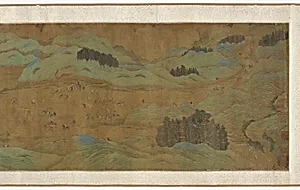
Treaty at the Bian Bridge 《汴橋會盟圖》
16th-17th century
Classification
Painting
Department
Smithsonian Collection
Museum
Smithsonian American Art Museum
Credit
Gift of Charles Lang Freer
Accession Number
F1909.238
Rights
Public Domain
Tags
About this artwork
To 1909
Art Historical Context
This painting, known as *Treaty at the Bian Bridge*, captures a pivotal moment of diplomacy in Chinese history. Created in the 16th or 17th century during the Ming dynasty, it shows an emperor on horseback meeting with figures across a bridge, symbolizing a formal alliance or negotiation. Though once attributed to the renowned artist Qiu Ying, scholars now view it as a work in his tradition rather than by his hand. The composition employs the classic blue-and-green style long associated with Qiu Ying, using mineral pigments to create luminous landscapes that blend history and imagination. Such paintings served not only as visual records of important events but also as elegant reminders of imperial authority and the harmony between ruler and realm. Part of the Charles Lang Freer collection, this work entered the Smithsonian through his generous gift before 1909. It offers visitors a window into Ming-era tastes for narrative landscapes that celebrated both cultural memory and artistic refinement.