
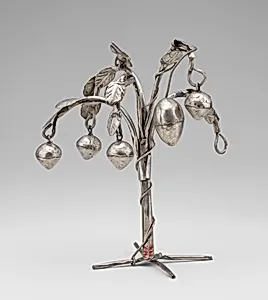
Tree
13th–15th century
Medium
Silver (hammered)
Dimensions
H. 4 3/4 × W. 4 × D. 3 1/2 in. (12.1 × 10.2 × 8.9 cm)
Classification
Metal-Sculpture
Culture
Chimú or Chancay
Department
Arts of Africa, Oceania, and the Americas
Museum
Metropolitan Museum of Art, New York, NY
Credit
Bequest of Jane Costello Goldberg, from the Collection of Arnold I. Goldberg, 1986
Accession Number
1987.394.657
Rights
Public Domain
Tags
Art Historical Context
This delicate silver tree, crafted by Chimú or Chancay artists the 13th and 15th centuries, exemplifies extraordinary metalworking prowess of Peru's northern coast cultures during the Late Intermediate Period. Standing just 4¾ inches tall, this hammered silver sculpture captures the organic form of a tree with graceful branches, likely evoking the natural world central to Andean life. Attributed to either the Chimú—known for their vast adobe metropolis of Chan Chan—or the Chancay, with their distinctive coastal traditions, it reflects a shared mastery of precious metals before the Inca conquest. Hammered from a thin silver sheet, the piece demonstrates repoussé techniques, where the metal was meticulously shaped, chased, and detailed by hand using simple stone or wooden tools. This labor-intensive process allowed artisans to achieve intricate textures and volume in miniature scale, highlighting the cultures' reverence for silver as a symbol of elite status and ritual power. Today, housed in the Metropolitan Museum of Art's Department of the Arts of Africa, Oceania, and the Americas, this bequest from Jane Costello Goldberg invites us to marvel at pre-Columbian ingenuity and the timeless allure of nature in art.