
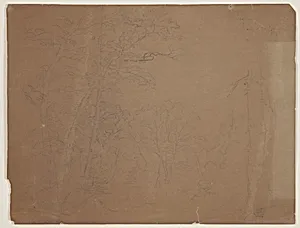
Trees, Grand Manan Island, Canada
August–September 1851
Classification
landscapes
Department
Smithsonian Collection
Museum
Smithsonian American Art Museum
Credit
Gift of Louis P. Church
Accession Number
1917-4-29
Rights
Public Domain
About this artwork
Research in Progress
Art Historical Context
Frederic Edwin Church, a leading figure in the Hudson River School of American landscape painting, captured the rugged beauty of Grand Manan Island, Canada in *Trees, Grand Manan, Canada* during August–September 1851. At just 25 years old Church was already honing his signature style, influenced by his mentor Thomas Cole. This early work reflects the movement's reverence for the American wilderness and its expansive natural vistas, portraying the island's windswept trees as symbols of untamed power and sublime tranquility. Painted during Church's travels to explore maritime scenes, the artwork exemplifies the Hudson River School's emphasis on detailed observation of light, atmosphere, and topography. Though the medium remains unidentified amid ongoing research, its classification as a landscape underscores Church's lifelong passion for depicting nature's grandeur—from Niagara Falls to the Andes—which elevated American art on the world stage. Grand Manan, with its dramatic cliffs and Atlantic vistas, provided a perfect subject for his precise, luminous technique. Now part of the Smithsonian American Art Museum's collection through a gift from Louis P. Church, this piece offers a glimpse into the artist's formative years, bridging intimate studies of flora with his later monumental canvases. Visitors will appreciate how it embodies 19th-century Romanticism's awe for the New World's wild frontiers.