
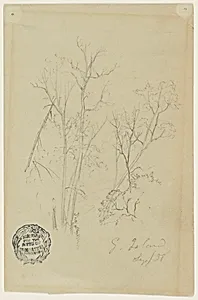
Trees on Goat Island, Niagara Falls, New York
September 1858
Classification
nature studies
Department
Smithsonian Collection
Museum
Smithsonian American Art Museum
Credit
Gift of Louis P. Church
Accession Number
1917-4-1302-a
Rights
Public Domain
About this artwork
Research in Progress
Art Historical Context
Frederic Edwin Church, master of the Hudson River School captured the raw beauty of American wilderness in works that celebrated nature's sublime power. Painted in September 1858 during one of his visits to Niagara Falls, *Trees on Goat Island, Niagara Falls, New York* on the island's rugged trees, a sliver of land dividing the thundering American and Horseshoe Falls. As a nature study, it Church's meticulous approach to observing and documenting the landscape, honing details that would elevate his grand panoramic paintings. Church's Hudson River School style blended Romanticism with precise realism, portraying nature as both majestic and spiritually evocative amid 19th-century America's expanding frontiers. Goat Island, accessible yet dwarfed by the falls' roar, symbolized untamed wilderness close to civilization. Though the medium remains unidentified—likely oil sketch or drawing on paper—this intimate study underscores Church's fieldwork dedication, informing iconic works like his sensational 1857 *Niagara*. Now in the Smithsonian American Art Museum's collection, gifted by Church's son Louis P. Church, it invites visitors to appreciate the artist's groundwork for evoking awe. Research continues, revealing more about this quiet testament to Niagara's enduring allure.