
Trestle Table
c. 1939
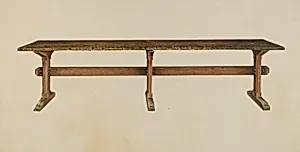
Medium
watercolor, colored pencil, and graphite on paperboard
Dimensions
overall: 32.9 x 54.2 cm (12 15/16 x 21 5/16 in.) Original IAD Object: 12'2 1/2"long; 2'wide; 3'high
Classification
Index of American Design
Department
CG-W
Museum
National Gallery of Art, Washington, D.C.
Credit
Index of American Design
Accession Number
1943.8.5893
Rights
Public Domain
Art Historical Context
**Trestle Table** Isadore Goldberg (. 1939) is a captivating rendering from the Index of American Design, a landmark WPA Federal Art Project launched during the Great Depression. This initiative employed artists across the U.S. to document everyday American objects through meticulous watercolor drawings, preserving the nation's folk art and craftsmanship for future generations. Goldberg's depiction captures a classic trestle table—measuring an impressive 12 feet 2½ inches long, 2 feet, and 3 feet—highlighting its sturdy, functional form rooted in early American vernacular design. Rendered in watercolor, colored pencil, and graphite on paperboard (32.9 x 54.2 cm), the work showcases Goldberg's skill in blending vibrant hues with precise lines to convey texture, grain, and proportion. These mixed-media techniques were standard for the Index, allowing artists to evoke the tactile reality of wooden furniture while emphasizing regional aesthetics. Trestle tables like this were practical staples in colonial homes, taverns, and farms, symbolizing resilient American ingenuity. Housed in the National Gallery of Art's collection, this piece underscores the cultural value of the Index, which produced over 15,000 renderings. It invites visitors to appreciate how such humble designs reflect our shared heritage, bridging art, history, and everyday life.
About the Artist
Isadore Goldberg · 1904–1995
Isadore Goldberg (b. 1904), an American artist, gained recognition through his contributions to the Index of American Design, a New Deal-era initiative under the Works Progress Administration's Federal Art Project. Active primarily in the late 1930s and early 1940s, Goldberg produced meticulous renderings of everyday American objects, capturing the essence of folk craftsmanship during a time when ...