
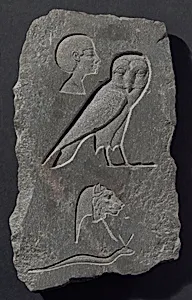
Trial Piece with Hieroglyphs
Early Ptolemaic Period, about 300 BCE
Medium
Granite
Dimensions
23.4 × 14 × 2.5 cm (9 3/8 × 5 1/2 × 1 in.)
Classification
sculpture/stone
Department
Arts of Africa
Museum
Art Institute of Chicago
Accession Number
78161
Rights
Public Domain
About this artwork
Artists used stone remnants left over from larger works to practice carving hieroglyphic signs and decorative elements. Here, the profiles of a man and a feline deity may be studies for larger works. Two hieroglyphs also appear on the thin slab. First used around 3000 BCE, ancient Egyptian hieroglyphs used images to convey sounds and meaning in writing. The undulating horned viper at the bottom of this piece represents the sound f, while the large owl in the center has the phonetic value m.
About the Artist
Ancient Egyptian
Ancient Egyptian artists, a collective of highly skilled artisans spanning over three millennia from the Predynastic period (c. 6000–3150 BC) to the Roman era (30 BC–4th century AD), produced some of humanity's most enduring masterpieces. These anonymous craftsmen, often organized in state-sponsored workshops, lived in dedicated communities like Deir el-Medina near Luxor during the New Kingdom (c....