
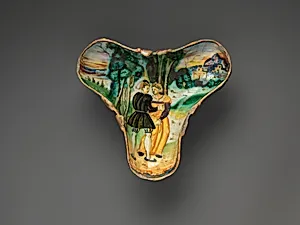
Trilobed vessel with Two Lovers in a Landscape
Unknown Artist
ca. 1540–45
Medium
Maiolica (tin-glazed earthenware), lustered
Dimensions
Overall (confirmed): 2 7/8 × 7 1/4 × 6 1/2 in. (7.3 × 18.4 × 16.5 cm)
Classification
Ceramics-Pottery
Culture
Italian, perhaps Urbino with Urbino or Gubbio luster
Department
European Sculpture and Decorative Arts
Museum
Metropolitan Museum of Art, New York, NY
Credit
Samuel D. Lee Fund, 1941
Accession Number
41.49.1
Rights
Public Domain
Tags
Art Historical Context
This delightful trilobed vessel, crafted around 1540–45 by an unknown Italian artist, captures a tender moment of romance: two lovers embraced in a lush landscape. Shaped with three rounded lobes for an elegant, scalloped form, it measures just under 3 inches tall and 7 inches wide, making it a perfect tabletop treasure from the Renaissance era. Housed in the Metropolitan Museum of Art's European Sculpture and Decorative Arts department, it exemplifies the exquisite ceramics produced in central Italy, possibly Urbino, renowned for its masterful lusterwork. Maiolica, a tin-glazed earthenware, was the medium of choice for its ability to hold brilliant, enamel-like colors that wouldn't fade. The addition of luster—a metallic iridescent glaze derived from Islamic techniques and perfected in Italian workshops like those in Gubbio—gives the surface a shimmering, jewel-like glow, elevating everyday pottery to luxury art. This vessel's vibrant scene reflects the Renaissance fascination with humanism, nature, and courtly love, themes popular in decorative arts of the time. Though small, its intricate narrative and technical sophistication highlight Italy's dominance in 16th-century ceramics, objects cherished by elites for dining and display. A true gem of the period! (198 words)