
Trinket Box
Unknown Artist
1830–70
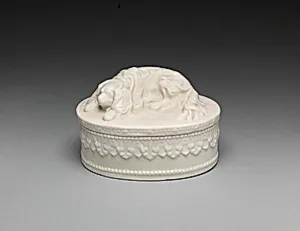
Medium
Parian porcelain
Dimensions
3 1/4 x 4 3/4 x 3 1/4 in. (8.3 x 12.1 x 8.3 cm)
Classification
Trinket box
Culture
American
Department
The American Wing
Museum
Metropolitan Museum of Art, New York, NY
Credit
Gift of Dr. Charles W. Green, 1947
Accession Number
47.90.54a, b
Rights
Public Domain
Tags
Art Historical Context
Nestled in The American Wing of the Metropolitan Museum Art, this charming *inket Box* (183–70) exemplifies the artistry of American Parian. Crafted by an unknown artist, the petite box measures just 3¼ x 4¾ x 3¼ inches, making it a perfect tabletop treasure for holding jewelry or small keepsakes. Parian porcelain an unglazed bisque ware mimicking the soft glow of Parian marble from the Greek island of Paros, gained popularity in the mid-19th century as an affordable alternative to marble sculpture, allowing mass production of refined decorative objects. Produced during America's antebellum and Civil War eras, this piece reflects the rising demand for elegant home furnishings among the growing middle class. Factories in Bennington, Vermont, and other centers churned out Parian wares, blending European techniques with American ingenuity. The animal motifs—likely adorning its surface or lid—add a whimsical touch, evoking the era's fascination with nature and the pastoral ideal amid rapid industrialization. Gifted to the Met in 1947 by Dr. Charles W. Green, this trinket box invites us to appreciate the everyday beauty of Victorian domestic life, where even utilitarian items doubled as sculptural delights. A testament to anonymous craftsmanship, it whispers stories of 19th-century refinement.