
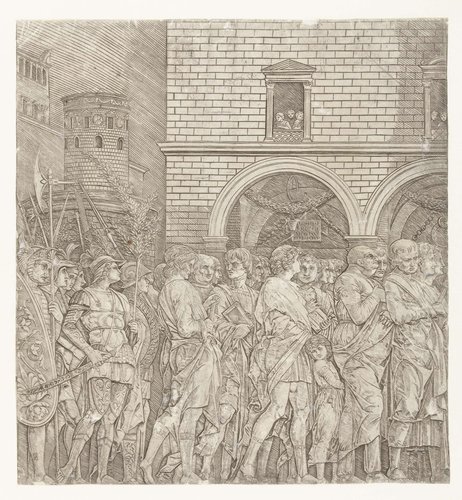
Triomf van Caesar
1486 - 1492
Medium
engraving
Dimensions
267; 287
Rights
Public Domain
About this artwork
Prent gebaseerd op ontwerpen voor een Triomf van Caesar door Andrea Mantegna. Van Mantegna's triomf zijn negen cartons bekend van welke de voorstellingen niet geheel overeenkomen met de serie prenten. Deze scène komt op geen van de cartons voor. Waarschijnlijk beschikten de graveurs over de tekeningen met studies in de fase voordat Mantegna een besluit had genomen over de definitieve vorm (zie documentatie).
Art Historical Context
Behold *Triomf van Caesar* (Triumph of Caesar), an exquisite engraving by Andrea Mantegna, created between 1486 and 1492. Measuring 287 mm high by 267 mm wide, print captures the Renaissance master's fascination with ancient Roman grandeur. Mantegna, a pioneering Italian artist from the early Renaissance, drew inspiration from classical texts describing Julius Caesar's victorious procession after his Gallic campaigns. Commissioned by the powerful Gonzaga family of Mantua, where Mantegna served as court painter, the work reflects the era's humanist revival of antiquity, blending historical narrative with meticulous draftsmanship. This scene forms part of a renowned series of engravings based on Mantegna's designs for his monumental *Triumph of Caesar*—nine large-scale cartoons (preparatory drawings) that served as models for tapestries. Intriguingly, this particular composition does not appear on any surviving cartons, suggesting it derives from Mantegna's preliminary studies, before he finalized the compositions. Engravers likely worked from these early sketches, offering us a rare glimpse into the artist's creative process. As one of the first widespread print series in Europe, these engravings revolutionized art dissemination, making Mantegna's innovative perspective, dynamic figures, and classical motifs accessible beyond elite patrons. They embody the Renaissance triumph of art over time, inviting us to march alongside Caesar's spoils.
About the Artist
Andrea Mantegna · 1431–1506
Andrea Mantegna was born around 1431 near Padua, in the Venetian Republic, the son of a carpenter. At approximately age eleven he was taken into the workshop of the Paduan painter and antiquities collector Francesco Squarcione, who enrolled him as a guild member and immersed him in the study of Roman sculpture and classical Latin. Though Mantegna later claimed that Squarcione had exploited his lab...