
Trionfo Di Virtu. Libro Novo..., page 18 (recto)
1563
Medium
Woodcut
Dimensions
Overall: 9 13/16 x 7 7/8 in. (25 x 20 cm)
Classification
Books|Prints|Ornament & Architecture
Department
Drawings and Prints
Museum
Metropolitan Museum of Art, New York, NY
Credit
Harris Brisbane Dick Fund, 1937
Accession Number
37.47.1(34)
Rights
Public Domain
Tags
Art Historical Context
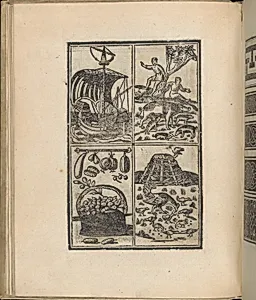
Welcome to the Metropolitan Museum of Art's and Prints collection, where Matteo Pagano's *Trionfo Di Virtu. Libro..., page 18 (o)* (1563) captivates with its Renaissance whimsy. This woodcut print, measuring 9 13/16 x 7 7/8 inches, comes from a Venetian publication blending allegory and ornament. Pagano, a skilled printer-engraver active in mid-16th-century Venice, specialized in books disseminating decorative motifs for artists and architects. The recto page bursts with eclectic imagery—men, chickens, pigs, and ships—arranged in a fantastical composition classified under ornament and architecture. Likely part of a "Libro Novo" (new book) celebrating the "Trionfo di Virtù" (Triumph of Virtue), it evokes triumphant processions or emblematic scenes where humble animals and vessels symbolize moral or worldly abundance, common in Renaissance emblem books. Woodcuts were pivotal then, enabling precise, affordable reproduction of intricate designs via carved blocks inked for relief printing. Acquired through the Harris Brisbane Dick Fund in 1937, this piece highlights how such prints fueled Europe's decorative arts revolution, from friezes to furniture, inviting us to ponder virtue's quirky triumphs.
About the Artist
Matteo Pagano · 1515–1588
**Matteo Pagano (c. 1515–1588)** was a prominent Venetian printer, publisher, woodcut artist, and illustrator whose innovative designs bridged fine art and the decorative crafts during the Renaissance. Little is known about his early life, which remains sparsely documented, but he began his career as a woodblock cutter, working for the publisher Nicolò Zoppino on pattern books before establishing ...