
Trionfo Di Virtu. Libro Novo..., page 22 (verso)
1563
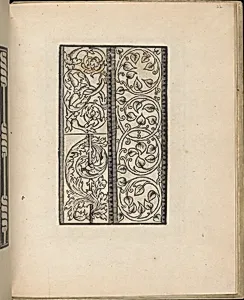
Medium
Woodcut
Dimensions
Overall: 9 13/16 x 7 7/8 in. (25 x 20 cm)
Classification
Books|Prints|Ornament & Architecture
Department
Drawings and Prints
Museum
Metropolitan Museum of Art, New York, NY
Credit
Harris Brisbane Dick Fund, 1937
Accession Number
37.47.1(43)
Rights
Public Domain
Tags
Art Historical Context
Step into the ornate world of Renaissance decoration with *Trionfo Di Virtu. Libro Novo...*, page 22 (verso), a delicate woodcut by Matteo Pagano from 1563. This print, measuring 9 13/16 x 7 7/8 inches, captures the Venetian artist's mastery of intricate ornamental designs, blending architectural motifs with fantastical grotesques—a hallmark of 16th-century pattern books. Pagano, a prolific publisher and engraver based in Venice, produced works like this to inspire artists, architects, and craftsmen, drawing from rediscovered classical Roman decorations unearthed during the Renaissance. Woodcuts like this one were revolutionary for their time, allowing for affordable reproduction of complex patterns through relief printing on wood blocks. In *Trionfo Di Virtu* ("Triumph of Virtue"), such pages served as visual encyclopedias of motifs—scrolls, strapwork, and mythical figures—fueling the era's passion for *grottesche*, whimsical interlacing forms that symbolized virtue triumphing over vice. Housed in the Metropolitan Museum of Art's Drawings and Prints department, this piece exemplifies how prints democratized high art, influencing everything from maiolica ceramics to book illustrations across Europe. Today, it reminds us of the Renaissance's playful fusion of antiquity and innovation, where beauty was both a scholarly pursuit and a practical tool for creation.
About the Artist
Matteo Pagano · 1515–1588
**Matteo Pagano (c. 1515–1588)** was a prominent Venetian printer, publisher, woodcut artist, and illustrator whose innovative designs bridged fine art and the decorative crafts during the Renaissance. Little is known about his early life, which remains sparsely documented, but he began his career as a woodblock cutter, working for the publisher Nicolò Zoppino on pattern books before establishing ...