
Tripod Vessel
Unknown Artist
5th century
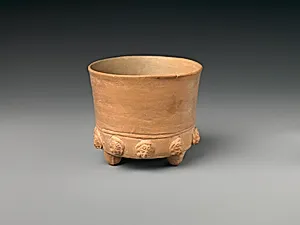
Medium
Ceramic
Dimensions
Height: 4 1/2in. (11.4cm) Diameter: 4 3/4in. (12.1cm)
Classification
Ceramics-Containers
Culture
Teotihuacan
Department
Arts of Africa, Oceania, and the Americas
Museum
Metropolitan Museum of Art, New York, NY
Credit
Gift of Arthur M. Bullowa, 1983
Accession Number
1983.497.17
Rights
Public Domain
Tags
Art Historical Context
This delicate Tripod Vessel, crafted in the 5th century by an unknown Teotihuacan, exemplifies the masterful ceramics of ancient Mesoamerica. Standing just 4½ inches tall with a 4¾-inch diameter, its compact form features three sturdy legs typical of tripod designs, which elevated vessels above heat sources for cooking or allowed them to rest stably during rituals. The inclusion of facial motifs—hinted at in its tagging—suggests appliquéd or incised faces, a common Teotihuacan motif evoking ancestors, deities, or protective spirits. Teotihuacan, a sprawling urban center near modern Mexico City that thrived from around 100 BCE to 650 CE, was a hub of artistic innovation and cultural exchange. These vessels were not mere utilitarian objects but held profound ritual significance, often used in offerings at temples like the Pyramid of the Sun. The ceramic medium, typically fired in kilns to produce durable orange ware, allowed for intricate surface treatments that blended everyday functionality with symbolic power. Today, this gift to the Metropolitan Museum of Art from Arthur M. Bullowa in 1983 invites us to ponder the daily lives and spiritual world of Teotihuacan's inhabitants, where art bridged the mundane and the divine.