
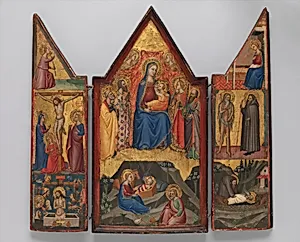
Triptych
ca. 1385–90
Medium
Poplar ?
Dimensions
Overall: 17 1/2 × 18 13/16 in. (44.5 × 47.8 cm) Sight: 17 1/2 × 7 3/4 in. (44.5 × 19.7 cm)
Classification
Frames
Culture
Italian, Tuscan
Department
Robert Lehman Collection
Museum
Metropolitan Museum of Art, New York, NY
Credit
Robert Lehman Collection, 1975
Accession Number
1975.1.69b
Rights
Public Domain
Tags
Art Historical Context
This exquisite Tuscan triptych dating to around 1385–90, hails from the vibrant artistic heart of late medieval Italy. Crafted from poplar wood—a lightweight choice ideal for portable devotional objects—its compact dimensions (overall 17½ × 18⅞ inches) suggest it was designed for private worship, perhaps in a noble household or chapel. Now housed in the Metropolitan Museum Art's Robert Lehman Collection 1975, it the refined craftsmanship of Tuscan workshops during the transition from Gothic to early Renaissance styles. The triptych unfolds to reveal poignant religious scenes: a central Madonna and Child flanked by a Crucifixion, as indicated by its thematic tags. These motifs were central to Italian devotional art, inviting contemplation of maternal tenderness and Christ's sacrifice. The "sight" size of 17½ × 7¾ hints at delicately framed panels, emphasizing the era's innovative use of hinged wings for intimate, foldable altarpieces. As a classified "frame" within the collection, this piece highlights the structural artistry of Tuscan woodworkers, whose precise joinery and gilding supported painted icons. It offers a window into 14th-century piety, where such objects bridged the divine and everyday life, blending spiritual devotion with emerging humanistic expression.