
Triptych with Scenes from the Life of Christ
1350–75
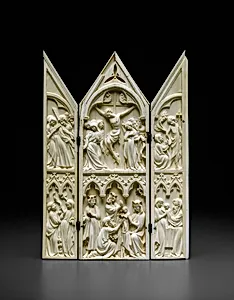
Medium
Ivory with traces of gold
Dimensions
25.7 × 17.5 cm (10 1/8 × 6 15/16 in.)
Classification
triptych
Department
Painting and Sculpture of Europe
Museum
Art Institute of Chicago
Accession Number
25332
Rights
Public Domain
About this artwork
Ivory was used to make highly prized devotional objects in the Gothic era. This triptych features scenes from the infancy and Passion of Christ, arranged in a chronological sequence from left to right, starting at the bottom with the Annunciation, the Adoration of the Magi, and the Presentation in the Temple. The narrative continues in the top register with the Road to Calvary, Christ on the Cross, and the encounter of Christ and Mary Madgalen after the Resurrection. Such small devotional object...
Art Historical Context
the Gothic era, small ivory triptychs like this one gave lay owners a private focus for prayer, condensing the arc of Christ’s life into a compact object that could travel between residences. The lower register follows the early narrative from the angel’s announcement to Mary through the Magi’s gifts and the presentation of the infant at the temple. Above, the sequence turns to the final days: the climb toward execution, the moment on the cross, and the meeting with Mary Magdalene after the resurrection. The hinged wings allow the owner to open or close the narrative at will, while the two registers create a deliberate shift from intimate domestic episodes below to the crowded public drama above. Within each compartment the carver has packed figures into shallow spaces, using overlapping bodies and raised hands to guide the eye across the story without any single scene dominating. This German ivory with traces of gold, carved between 1350 and 1375 and now at the Art Institute of Chicago, rewards a close look at the small kneeling figure offering a gift in the lower central panel; the careful folds of the robe and the turned head show how the artist used minute surface detail to slow the viewer’s attention on that single act of homage.
About the Artist
German
**German, Franconia (active ca. 1485–1500)** was an anonymous artist from the Franconian region of northern Bavaria, Germany, renowned for his contributions to late Gothic graphic arts. Little is known of his early life or training, as details about many anonymous masters from this era remain undocumented. Franconia, with its vibrant artistic centers like Nuremberg, fostered a rich tradition of re...