
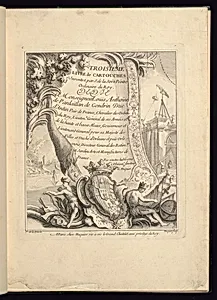
Troisieme Livre de Cartouches
Medium
ornament
Classification
ornament
Department
Smithsonian Collection
Museum
Smithsonian American Art Museum
Credit
Purchased for the Museum by the Advisory Council
Accession Number
1921-6-326-1
Rights
Public Domain
About this artwork
Research in Progress
Art Historical Context
**Troisieme Livre de Cart** (Third Book of Cartouches created by French artist Jacques de Lajoüe in 1740, exemplifies exuberant Rococo style that flourished in 18th-century France. De Lajoüe (1687–1761), a master of decorative arts, was renowned for his intricate designs blending architecture, painting, and printmaking. This work, classified as an ornament print or etching collection, features elaborate *cartouches*—ornate, scrolling frames often used to enclose coats of arms, inscriptions, or decorative motifs in architecture, furniture, and book illustrations. Produced during the height of Louis XV's reign, it reflects the era's taste for playful asymmetry, floral flourishes, and shell-like curves, moving away from the grandeur of Baroque toward lighter, more whimsical elegance. As a *livre* (book) of designs, it served as a pattern book for artisans, architects, and designers, disseminating innovative motifs across Europe. De Lajoüe's precise etching technique allowed for fine details that could be easily reproduced, influencing interiors from Versailles salons to provincial chateaus. Today, housed in the Smithsonian American Art Museum's Smithsonian Collection—purchased by the Advisory Council—this rare piece bridges European decorative traditions with American collections, highlighting transatlantic artistic exchange. Though research continues, it invites visitors to appreciate how such ornaments shaped the opulent visual culture of the Enlightenment.