
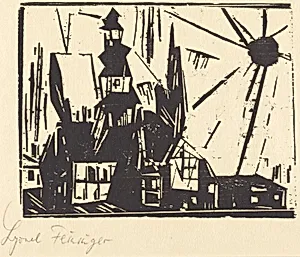
Troistedt (Lehnstedt)
1919
Medium
woodcut in black on laid paper
Classification
Department
CG-W
Museum
National Gallery of Art, Washington, D.C.
Credit
Rosenwald Collection
Accession Number
1964.8.765
Rights
Public Domain
Art Historical Context
Lyonel Feininger's *Troistedt (Lehnstedt)*, a striking 1919 woodcut in black on laid paper, the artist's fascination with crystalline forms and fragmented architecture. Born in New York but deeply immersed in Germany's art scene, Feininger a key figure in Expressionism and a founding master at the Bauhaus, where he began teaching that very year. This print, housed in the National Gallery of's Rosenwald Collection, the post-World War I era's introspective energy, blending Cubist geometry with a luminous, prismatic quality unique to his vision. Woodcuts like this one showcase Feininger's mastery of the medium's bold, tactile lines and textures, carved directly into wood blocks for a raw, energetic print. The stark black ink on laid paper—valued for its subtle texture—evokes ethereal light piercing angular village structures, possibly inspired by rural German locales like Troistedt or Lehnstedt. His technique emphasizes rhythm and distortion, transforming everyday scenes into otherworldly visions. As part of the Print department (CG-W), this work highlights Feininger's innovative bridge between painting and printmaking, influencing modern graphic arts and inviting viewers to ponder the interplay of light, form, and memory in turbulent times.
About the Artist
Lyonel Feininger · 1871–1956
Lyonel Feininger (1871–1956) was born in New York City to German-American parents who were accomplished musicians. At sixteen he was sent to Hamburg to pursue musical training, but upon arriving in Germany he turned instead to visual art, enrolling in the Allgemeine Gewerbeschule in Hamburg and subsequently at the Königliche Akademie der Künste in Berlin, where he studied painting. He subsequently...