
Troopships
Classification
Department
Smithsonian Collection
Museum
Smithsonian American Art Museum
Credit
Gift of Charles Lang Freer
Accession Number
F1888.3
Rights
Public Domain
Tags
About this artwork
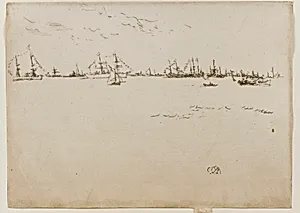
Whistler etchings are identified by "G" numbers as assigned in "James McNeill Whistler: The Etchings, a catalogue raisonne," by Margaret F. McDonald, Grischka Petri, Meg Hausberg, and Joanna Meacock (University of Glasgow, 2012), http://etchings.arts.gla.ac.uk. This print is G307 state 2 of 2.
Art Historical Context
James McNeill Whistler’s 1887 etching “Troopships” captures a quiet maritime scene with the artist’s signature economy of line. Created late in his career, the print reflects Whistler’s lifelong fascination with harbors, ships, and the subtle play of light on water—subjects he explored across decades of printmaking. Identified as G307 in the standard catalogue of his etchings, this second and final state demonstrates his meticulous approach to refining composition and atmosphere. Although the precise subject remains open to interpretation, the title suggests a naval or military context, possibly alluding to troop movements during the late Victorian era. Whistler’s delicate use of etching allowed him to distill complex scenes into evocative tonal harmonies, aligning with the Aesthetic movement’s emphasis on beauty over narrative. The work’s presence in the Smithsonian American Art Museum, gifted by Charles Lang Freer, underscores its place within one of the finest public collections of Whistler’s graphic art. Visitors can appreciate how this modest-sized print rewards close looking: faint lines and open space evoke both the vastness of the sea and the transient nature of the vessels. It stands as a fine example of Whistler’s ability to transform everyday observation into timeless visual poetry.