
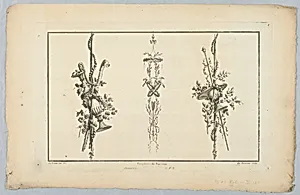
Trophies with Attributes of Bacchus
ca. 1778–1782
Classification
Department
Smithsonian Collection
Museum
Smithsonian American Art Museum
Credit
Gift of Eleanor and Sarah Hewitt
Accession Number
1931-94-623
Rights
Public Domain
About this artwork
Research in Progress
Art Historical Context
Discover the enchanting *Trophies with Attributes ofchus* by French artist Richard de Lal, created around 1778–1782. Active during the late 18th century (0–96), Lalonde specialized in ornamental prints that captured the refined elegance of pre-Revolutionary France. This work, classified as a print the Smithsonian American Art Museum collection (gift of Eleanor and Sarah Hewitt), exemplifies the decorative motifs popular among architects and designers of the Louis XVI era. The title evokes classical trophies—artistic assemblages of symbolic objects like garlands, vessels, and instruments—adorned with attributes of Bacchus, the Roman god of wine and revelry. Imagine clusters of grapes, vines, thyrsus staffs, and amphorae arranged in harmonious compositions, blending neoclassical symmetry with playful abundance. As a print, its medium allowed for precise reproduction, making it a valuable pattern source for furniture, wallpapers, and silverwork, reflecting France's thriving decorative arts scene. Though research continues, this piece highlights how 18th-century artists revived antiquity to celebrate indulgence and festivity amid Enlightenment ideals. A delightful glimpse into opulent tastes before the Revolution! (178 words)