
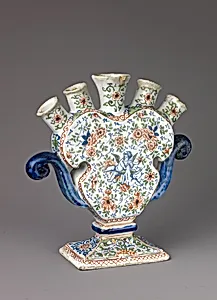
Tulip Vase
Unknown Artist
ca. 1700–1720
Medium
Tin-glazed earthenware
Dimensions
Height: 8 1/8 in. (20.6 cm)
Classification
Ceramics
Culture
Dutch (Delft)
Department
Robert Lehman Collection
Museum
Metropolitan Museum of Art, New York, NY
Credit
Robert Lehman Collection, 1975
Accession Number
1975.1.1616
Rights
Public Domain
Tags
Art Historical Context
This charming Tulip Vase, crafted in Delft, Netherlands around 1700–1720, exemplifies the golden era of Dutch Delftware. Made from tin-glazed earthenware—a technique where a tin oxide coating creates a glossy, white surface ideal for vibrant painted designs—this modest 8 1/8-inch (20.6 cm) ceramic was designed to hold the era's prized tulip bulbs or cut flowers. Delft potters masterfully mimicked expensive Chinese porcelain, making luxury accessible to the burgeoning Dutch middle class during the height of the Republic's prosperity. The vase's decoration features playful putti—chubby, winged cherubs inspired by Renaissance and Baroque motifs—adding a whimsical, celebratory touch. These lively figures reflect the cultural fascination with tulips, symbols of wealth and beauty even after the infamous "Tulip Mania" bubble of the 1630s. As a functional yet ornamental object, it highlights Delft's role as Europe's ceramics capital, blending utility with artistic flair. Now part of the Robert Lehman Collection at The Metropolitan Museum of Art (acquired 1975), this anonymous masterpiece invites us to appreciate the everyday elegance of 18th-century Dutch life, where even a simple vase could evoke opulence and joy.