
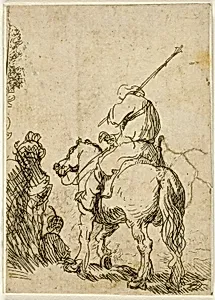
Turbaned Soldier on Horseback
c. 1629
Medium
Etching on paper
Dimensions
Image/plate: 8 × 5.6 cm (3 3/16 × 2 1/4 in.); Sheet: 8.1 × 5.7 cm (3 1/4 × 2 1/4 in.)
Classification
etching
Department
Prints and Drawings
Museum
Art Institute of Chicago
Accession Number
49073
Rights
Public Domain
Art Historical Context
**Turbaned Soldier on Horse**, an etching by Rembrandt van R created around 1629, captures the dynamic energy of a mounted warrior in exotic attire. At just 8 × 5.6 cm, this print showcases a turbaned figure charging forward on horseback, sword raised, evoking the thrill of battle. Produced during Rembrandt's early years in Leiden, when he was only in his early twenties, it reflects his fascination with dramatic poses and Orientalist themes popular in 17th-century Dutch art, inspired by tales of distant lands and military prowess. Rembrandt revolutionized etching, a printmaking technique using acid to bite lines into a metal plate. Here, his masterful use of cross-hatching and burr creates rich textures—the flowing turban, the horse's muscled form, and subtle shadows that suggest movement and depth. Unlike paintings, etchings allowed artists to produce multiples, making Rembrandt's genius accessible beyond elite patrons. Housed in the Art Institute of Chicago's Prints and Drawings Department, this work highlights Rembrandt's precocious talent and enduring influence on Baroque printmaking. Visitors will appreciate how such a tiny sheet bursts with life, a testament to his innovative spirit.
About the Artist
Rembrandt van Rijn · 1606–1669
Rembrandt Harmenszoon van Rijn (1606–1669) stands as one of the greatest visual artists in the history of Western art and the most important Dutch painter of the 17th century. Born in Leiden to a prosperous miller's family, Rembrandt transformed painting through his revolutionary use of light and shadow, his psychological depth in portraiture, and his elevation of etching to a fine art. His approx...