
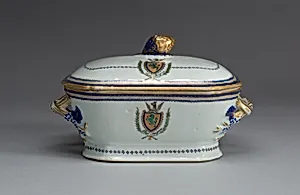
Tureen with Cover
c. 1787–90
Medium
Hard-paste porcelain, glaze, with enamels in colors, and gilding
Dimensions
11.4 × 19.7 × 11.4 cm (4 1/2 × 7 3/4 × 4 1/2 in.)
Classification
chinese export porcelain
Department
Arts of the Americas
Museum
Art Institute of Chicago
Accession Number
3585
Rights
Public Domain
About this artwork
This tureen is from a service owned by Elias Morgan (1770–1812) of Connecticut. The Morgan set, displaying the coat of arms originally used by his Welsh ancestors, is one of the few armorial services made for the American market.
Art Historical Context
This elegant *Tureen with Cover*, crafted around 1787–90, exemplifies the pinnacle of Chinese export porcelain during late 18th century Made from durable hard-paste porcelain—a-fired body prized for its strength, translucency, and fine white color—the piece is adorned with vibrant overglaze enamels in multiple colors and intricate gilding. Measuring a compact 11.4 × 19.7 × 11.4 cm, it served as a luxurious serving vessel for soups or stews on elite dining tables, its lidded design ensuring practicality and grandeur. Produced in China for Western markets, particularly Europe and the Americas, this tureen reflects the booming global trade networks of the era. Chinese potters mastered European-inspired shapes and motifs, blending Eastern technical virtuosity with Western tastes to create coveted dinnerware services. The enameling technique, fired at lower temperatures over the glaze, allowed for rich polychrome decoration, while gilding added a shimmering opulence symbolizing wealth. Housed in the Art Institute of Chicago's Arts of the Americas department, this artifact highlights transatlantic cultural exchange, bridging Asian craftsmanship with New World consumers during a time of revolutionary change. A testament to porcelain's role in diplomacy and luxury, it invites us to savor the artistry of cross-continental connections.