
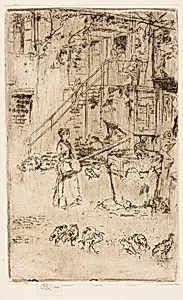
Turkeys
Medium
Etching and drypoint with foul biting in black ink on ivory laid paper
Dimensions
Image, trimmed within platemark: 20.8 × 13.1 cm (8 1/4 × 5 3/16 in.); Sheet: 22.2 × 13.2 cm (8 3/4 × 5 1/4 in.)
Classification
etching
Department
Prints and Drawings
Museum
Art Institute of Chicago
Accession Number
50986
Rights
Public Domain
Art Historical Context
James McNeill Whistler’s *Turkeys* (1880) is a masterful example of his innovative printmaking, capturing the subtle beauty of everyday subjects through etching and drypoint on ivory laid paper. Measuring just 20.8 × 13.1 cm, this intimate work from the Art Institute of Chicago’s Prints and Drawings collection showcases Whistler’s commitment to the Aesthetic movement, where art prioritized harmony, tone, and suggestion over narrative detail. As an American-born artist working in Britain, Whistler revolutionized printmaking in the late 19th century, drawing inspiration from Japanese art and old masters like Rembrandt. The technique here is particularly striking: etching uses acid to bite intricate lines into a copper plate, while drypoint adds rich, velvety burrs from direct needle scratches, creating atmospheric depth. “Foul biting”—unintentional acid corrosion—lends a textured, organic quality, enhancing the work’s moody elegance and evoking the play of light on feathers. Produced during Whistler’s prolific Venice period, *Turkeys* reflects his shift toward subtle tonalism, making prints accessible yet exquisite collector’s items. This piece invites visitors to appreciate the artistry in the mundane, a hallmark of Whistler’s legacy in bridging painting and print traditions.
About the Artist
James McNeill Whistler · 1834–1903
James Abbott McNeill Whistler (1834-1903) was an American-born painter and printmaker who became a leading figure in the Aesthetic Movement and pioneer of Tonalism and Japonisme. He revolutionized art by championing "art for art's sake" and treating paintings as visual equivalents of musical compositions, titling works as "arrangements," "harmonies," and "nocturnes" to emphasize formal qualities o...