
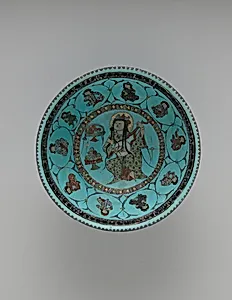
Turquoise Bowl with Lute Player and Audience
Unknown Artist
late 12th–early 13th century
Medium
Stonepaste; glazed (opaque monochrome), in-glaze- and overglaze-painted, gilded
Dimensions
H. 3 1/2 in. (8.9 cm) Diam. 7 3/4 in. (19.7 cm) Wt. 12.3 oz. (348.7 g)
Classification
Ceramics
Department
Islamic Art
Museum
Metropolitan Museum of Art, New York, NY
Credit
Henry G. Leberthon Collection, Gift of Mr. and Mrs. A. Wallace Chauncey, 1957
Accession Number
57.61.16
Rights
Public Domain
Tags
Art Historical Context
This exquisite turquoise bowl, created in the late 12th to early 13th century, captures a lively scene of a lute player performing for an attentive audience. Housed in the Metropolitan Museum of Art’s Islamic Art collection, the small yet finely ceramic piece reflects the rich life of the medieval world, where music and played central roles in social gatherings. Its intimate scale suggests it may have been used in private settings, inviting viewers to appreciate both its function and its decorative charm. The bowl’s artistic significance lies in its sophisticated stonepaste construction and multilayered decoration. Artisans applied an opaque monochrome glaze, then enhanced the surface with in-glaze and overglaze painting as well as gilding—a technically demanding process that allowed for vibrant colors and shimmering details. These innovations in ceramic technology, developed in the Islamic world, produced objects of remarkable beauty and durability that were highly prized across regions. Depicting musicians with lutes, the work offers a glimpse into the everyday pleasures and artistic expressions of its time. Such imagery highlights the integration of music within Islamic culture, celebrating both performance and the skilled craftsmanship that brought these moments to life on durable, elegant wares.