
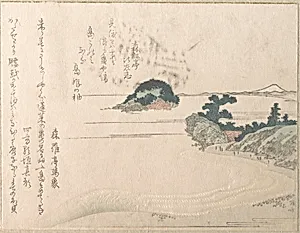
Turtle Island and Fujiyama
19th century
Medium
Woodblock print (surimono); ink and color on paper
Dimensions
5 1/2 x 7 1/8 in. (14 x 18.1 cm)
Classification
Prints
Culture & Period
Japan · Edo period (1615–1868)
Department
Asian Art
Museum
Metropolitan Museum of Art, New York, NY
Credit
H. O. Havemeyer Collection, Bequest of Mrs. H. O. Havemeyer, 1929
Accession Number
JP1950
Rights
Public Domain
Tags
Art Historical Context
Ryūryūkyo Shinsai’s “Turtle Island and Fujiyama” is a delicate surimono, a privately commissioned woodblock print produced during Japan’s Edo period. Created in the nineteenth century, this small-format work (just 5½ by 7⅛ inches) exemplifies the refined taste of urban collectors who valued the medium’s luminous color, subtle embossing, and occasional use of metallic pigments. Surimono often served as elegant New Year greetings or poetry accompaniments, blending literary and visual arts in intimate settings. The print depicts a tranquil landscape pairing Mount Fuji with Turtle Island, motifs rich in Japanese cultural symbolism. Fuji’s graceful cone evokes permanence and spiritual aspiration, while the island—linked to longevity through the auspicious crane-and-turtle motif—suggests harmony between nature and human hopes. Shinsai’s precise linework and gentle palette capture the atmospheric depth typical of late-Edo landscape prints, inviting viewers to pause and reflect on these enduring symbols. Housed today in the Metropolitan Museum of Art’s Asian Art collection as part of the H. O. Havemeyer bequest, the work offers a window into the refined visual culture of nineteenth-century Japan, where even the smallest print could convey profound poetic and philosophical resonance.
About the Artist
Ryūryūkyo Shinsai · 1799–1823
Ryūryūkyo Shinsai (柳々居辰斎), active from 1799 to 1823, was a prominent Japanese ukiyo-e printmaker based in Edo (modern Tokyo), renowned for his mastery of surimono—luxurious, privately commissioned woodblock prints produced for elite poetry circles and New Year's celebrations. He began his training under Tawaraya Sōri before becoming a student of the legendary Katsushika Hokusai, from whom he recei...