
Snowy Landscape
ca. 1820
Medium
Woodblock print (surimono); ink and color on paper
Dimensions
7 1/4 x 6 5/8 in. (18.4 x 16.8 cm)
Classification
Prints
Culture & Period
Japan · Edo period (1615–1868)
Department
Asian Art
Museum
Metropolitan Museum of Art, New York, NY
Credit
The Howard Mansfield Collection, Purchase, Rogers Fund, 1936
Accession Number
JP2582
Rights
Public Domain
Tags
Art Historical Context
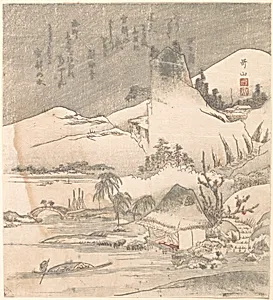
**Snowy Landscape** by Ishikawa Kazan, created around 1820, captures the beauty of a winter scene in Japan during the Edo period1615–1868). This intimate woodblock print, known as a *surimono*, measures just 7¼ × 6⅝ inches, designed for private commissions rather than mass production. Rendered in vibrant ink and color on paper it depicts snow-draped pavilions nestled in a tranquil landscape, evoking the quiet poetry of nature's hush. Surimono prints like this one were luxurious New Year's greetings or celebratory gifts among Japan's literati elite, often featuring embossed details, metallic pigments, and poetic inscriptions (though not visible here). Kazan (1786–1841), a scholar-painter blending ukiyo-e traditions with literati influences from China, excelled in such refined works. His style emphasized elegant composition and subtle color gradations, achieved through meticulous woodblock carving—a technique that allowed precise layering of colors for atmospheric depth. Housed in the Metropolitan Museum of Art's Asian Art collection (from The Howard Mansfield Collection, 1936), this print highlights Edo Japan's cultural flourishing, where art celebrated seasonal impermanence (*mono no aware*). Visitors will appreciate its delicate charm, a window into the refined tastes of 19th-century Japan.