
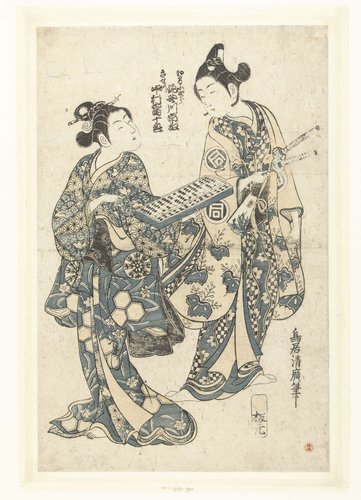
Twee acteurs met telraam
1752
Medium
color woodcut
Dimensions
281; 427
Rights
Public Domain
About this artwork
beeld: hoogte 427 mm x breedte 281 mm
Art Historical Context
**Twee acteurs met telam** (Two Actors with Abacus a vibrant color woodcut byii Kiyohiro from1752, captures the flair of Edo-period Japan Measuring 427 mm high by 281 mm wide, this print exemplifies the ukiyo-e tradition, or "pictures of the floating world," which celebrated everyday pleasures like kabuki theater. Kiyohiro, a master of the Torii—renowned for yakusha-e (actor prints)—skillfully portrayed performers in dynamic poses, here posed with an abacus, evoking a lively merchant or comedic scene from the stage. Created during Japan's Genroku era cultural boom, the artwork reflects kabuki's rising popularity among urban audiences in Edo (modern Tokyo). Woodblock prints like this were affordable, mass-produced art, democratizing access to celebrity culture and blurring lines between theater and visual storytelling. The Torii family's bold lines and expressive faces made their prints iconic billboards for plays. Kiyohiro's technique shines in the layered color woodcut process: separate blocks carved for each hue, hand-rubbed onto damp paper for rich gradients and textures. This innovation elevated ukiyo-e from black-and-white origins to full-color splendor, influencing global art. A window into 18th-century Japan's playful spirit, it invites visitors to imagine the roar of kabuki crowds.
About the Artist
Torii Kiyohiro · 1737–1776
Torii Kiyohiro (active 1737–1776) was a Japanese ukiyo-e artist and a member of the celebrated Torii school, one of the oldest and most distinguished lineages in the history of Japanese woodblock printing. The Torii school had been founded in the late seventeenth century and built its reputation on the creation of billboards and illustrated programs for the Kabuki theater in Edo, and Kiyohiro carr...