
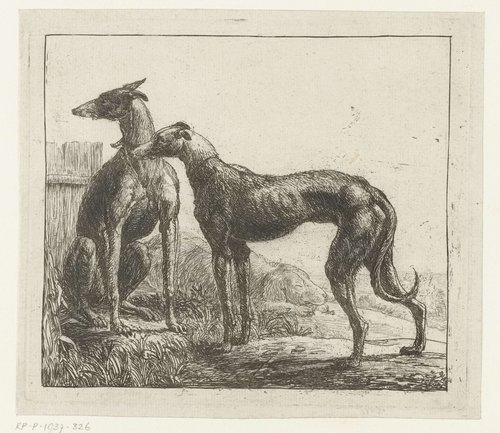
Twee hazewindhonden
1610 - 1653
Medium
drypoint
Dimensions
150; 133
Rights
Public Domain
About this artwork
collector's mark: Lugt 2760
Art Historical Context
**Twee Hazewindhonden (Two Greyhounds)**Simon de Vlieger a prominent Dutch Golden Age artist (c. 1600–1653), captures the sleek elegance of two greyhounds in this intimate drypoint etching. Measuring just 133 × 150 mm, the work exemplifies the precision of 17th-century printmaking where de Vlieger, best known for his dramatic seascapes and marine scenes, demonstrates his versatility with animal studies. Greyhounds, prized for hunting, evoke the aristocratic pastimes of the era, rendered with fluid lines that highlight their poised energy. Drypoint, de Vlieger's chosen medium here, involves scratching directly into a metal plate, raising a soft burr that produces rich, velvety textures in early impressions—ideal for conveying the dogs' muscular forms and glossy coats. This technique, more spontaneous than traditional engraving, allowed artists like de Vlieger to achieve expressive depth in small-scale works, making them accessible to collectors beyond oil paintings. Bearing the collector's mark Lugt 2760 (likely from a distinguished 19th- or 20th-century owner), this print reflects the enduring appeal of Dutch print culture. It invites visitors to appreciate how de Vlieger's masterful linework bridges the natural world and artistic innovation, a hallmark of the Golden Age's technical brilliance.
About the Artist
Simon de Vlieger · 1600–1653
Simon de Vlieger (c. 1600/1601–1653) was a leading Dutch marine painter of the Golden Age, born in Rotterdam where he married Anna Gerridts van Willige in 1627. His early training remains undocumented, though his initial works reflect the influence of tonal marine painting pioneered by Jan Porcellis, from whose monochrome palette de Vlieger transitioned toward more vibrant colors, precise ship det...