
Twee kariatiden
1675 - 1747
Medium
paper
Dimensions
191; 357
Rights
Public Domain
About this artwork
height 357 mm x width 191 mm
Art Historical Context
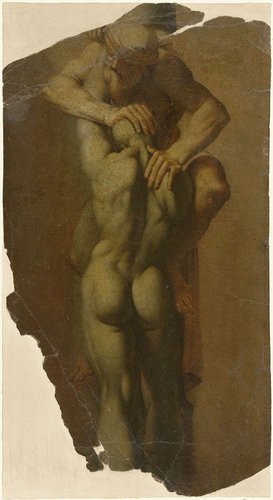
**Twee Kariatiden** by Giuseppe Maria Crespi1665–1747) is a delicate drawing on paper, measuring357 mm in height by 191 mm in width The title, Dutch for "Two Caryat," refers to sculpted female figures traditionally used as supports in classical architecture, evoking strength and grace. Crespi, a prominent Bolognese artist of the late Baroque period, captures these iconic forms in a preparatory study, showcasing his mastery of the human figure amid the artistic traditions of 17th- and 18th-century Italy. As a work on paper, this piece highlights the importance of drawings in Baroque workshops, where sketches like this served as vital studies for larger paintings, frescoes, or sculptures. Crespi's technique likely employs fluid lines and subtle shading—hallmarks of his realistic style influenced by the Carracci school—allowing artists to experiment with anatomy and pose before committing to grand commissions. This intimate artwork offers a glimpse into Crespi's creative process during a time when Bologna rivaled Rome as an artistic hub. For visitors, it celebrates the unsung role of paper studies in bridging classical antiquity with Baroque innovation, reminding us how everyday sketches fueled monumental art.
About the Artist
Giuseppe Maria Crespi · 1665–1747
Giuseppe Maria Crespi (1665–1747) was an Italian painter of the late Baroque period whose innovative genre scenes and unorthodox approach to religious painting made him one of the most original artists of early eighteenth-century Bologna. Born in Bologna, he trained under Domenico Maria Canuti, Carlo Cignani, and in the tradition of the Carracci academy, but developed a markedly personal style tha...