
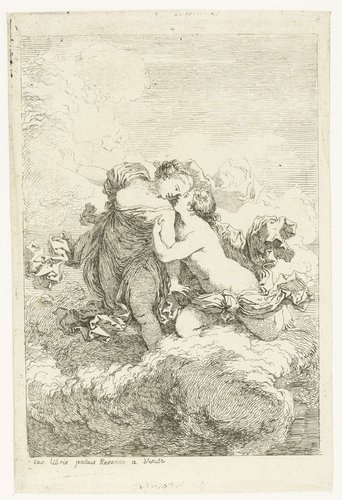
Twee vrouwen op een wolk
1763 - 1764
Medium
etching
Dimensions
114; 170
Rights
Public Domain
About this artwork
Gift of the heirs of Henny, Amsterdam
Art Historical Context
**Twee vrouwen op een w (Two Women on a Cloud Jean Honoré Fragonard 1763–1764 Step into the whimsical world of 18th French Rococo with Jean Honoré Fragonard's delicate etching *Twee vrouwen op eenolk* ("Two Women on a"). Created during Fragonard's mature period, this small-scale print (170 × 114 mm) captures playful, ethereal fantasy that defined Rococo art—an ornate style favoring lightness, sensuality, and aristocratic delight just before the shift to Neoclassicism. Fragonard, a master of exuberant scenes, here evokes a dreamlike reverie with two women perched on a billowing cloud, embodying the era's escapist charm amid France's opulent pre-Revolutionary courts. Etching, Fragonard's chosen medium, allowed for intricate lines and tonal subtleties through acid-etched copper plates, making fine art accessible beyond original paintings. This technique highlights his fluid, spontaneous style, reminiscent of his famous brushwork in oils like *The Swing*. The print's intimate size suits private collections, inviting close admiration of its graceful forms and airy composition. A cherished gift from the heirs of Henny in Amsterdam, this work underscores Fragonard's enduring appeal across Europe, bridging French elegance with Dutch appreciation for refined prints. It's a delightful window into Rococo's celebration of joy and imagination. (198 words)
About the Artist
Jean Honoré Fragonard · 1732–1806
Jean-Honoré Fragonard (1732-1806) was a French painter and printmaker whose late Rococo manner was distinguished by remarkable facility, exuberance, and hedonism. Born in Grasse, he moved to Paris where he trained under Jean-Baptiste Chardin and François Boucher, winning the prestigious Prix de Rome in 1752. After studying in Italy alongside Hubert Robert, Fragonard returned to Paris in 1761 to fi...