
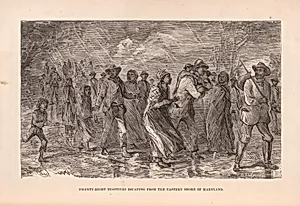
Twenty-Eight Fugitives Escaping from the Eastern Shore of Maryland
1872
Medium
Classification
Department
Smithsonian Collection
Museum
Smithsonian American Art Museum
Credit
National Portrait Gallery, Smithsonian Institution
Accession Number
S/NPG.2018.89.11
Rights
Public Domain
Tags
Art Historical Context
**Twenty-Eight Fugitivesaping from the Eastern Shore of Maryland** is a compelling 1872 print by F. Osler, in the Smithsonian American Art's collection and credited to the National Portrait. Created just seven years after the Civil's end, this work captures a dramatic moment of defiance against slavery, depicting 28 individuals fleeing from Maryland's Eastern Shore—a region pivotal to the Underground Railroad network that aided thousands of enslaved people in their quest for freedom. As a print, the medium was ideal for broad dissemination in the post-emancipation era, allowing historical narratives to reach wide audiences affordably through techniques like engraving or lithography. The scene evokes a rural landscape under rain, with poignant details such as bags for provisions, books symbolizing hope or literacy, hats, and jewelry that humanize the fugitives. Classified as both a print and portrait, it likely emphasizes individual faces and stories amid the perilous journey. This artwork holds cultural importance as a visual testament to resilience and abolitionist triumphs, reminding visitors of the human cost of bondage and the courage of escape. Osler's piece invites reflection on America's path from slavery to reconstruction, blending historical record with emotional depth.