
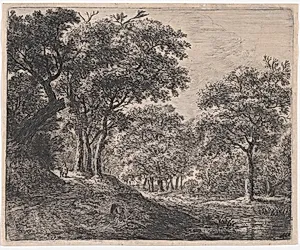
Twilight in the Woods
17th century
Medium
Etching; first state of two
Dimensions
sheet: 5 5/16 x 6 5/8 in. (13.5 x 16.8 cm)
Classification
Prints
Department
Drawings and Prints
Museum
Metropolitan Museum of Art, New York, NY
Credit
Gift of Kenneth Grebinar, 2005
Accession Number
2005.377.23
Rights
Public Domain
Tags
Art Historical Context
Anthonie Waterloo’s “Twilight in the Woods” invites viewers into a quiet forest scene rendered with delicate precision. Created in the 17th century, this small etching captures the dense interplay trees and foliage, suggesting the soft, fading light of dusk. work reflects the Dutch Golden Age interest in natural landscapes, where artists turned their attention to the textures and moods of the countryside rather than grand historical subjects. As an etching in its first state of two, the print preserves Waterloo’s initial vision before any later revisions to the copper plate. The medium’s fine, incised lines allow for intricate detail in the branches and undergrowth, while the modest size—just 5 5/16 by 6 5/8 inches—makes the image intimate and portable. Such prints were often collected for private enjoyment, offering a contemplative window onto nature’s rhythms. Now in the Metropolitan Museum of Art’s collection of Drawings and Prints, the etching continues to demonstrate how 17th-century artists used printmaking to translate the atmosphere of the woods into lasting form.
About the Artist
Anthonie Waterloo · 1609–1690
Anthonie Waterloo (1609–1690) was a prominent Dutch Golden Age landscape artist, born on May 6 in Lille, then part of the Spanish Netherlands. Little is known of his early life beyond his mother, Magdalena Vaillant, who joined Amsterdam's Walloon Church in 1621, with Waterloo following in 1630; no records exist of formal training, and he was likely self-taught. Registered as a painter in Amsterdam...