
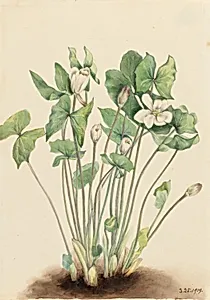
Twinleaf (Jeffersonia diphylla)
Medium
Painting
Classification
Painting
Department
Smithsonian Collection
Museum
Smithsonian American Art Museum
Credit
Smithsonian American Art Museum, Gift of the artist
Accession Number
1970.355.413
Rights
Public Domain
Tags
Art Historical Context
**Twinleaf (Jeffersonia diplla)**, painted by Mary Vaux Wal in 1919, the delicate beauty of this North American wildflower, native eastern woodlands. Named after Thomas Jefferson, *Jeffersonia diphylla—or Twinleaf— two heart-shaped leaves emerging from a single stem, topped by a fleeting white bloom in spring. Walcott's, now in the Smithsonian American Art through her generous gift, exemplifies her passion for documenting flora with scientific precision and artistic grace. pioneering artist, mountaineer, andist (1860–1940), Walcott this work amid her expeditions across Canada and the U.S., contributing to her acclaimed series *North American Wild Flowers* (published 1925). Active in the early 20th century, when women scientists faced barriers, her paintings bridged art and botany, aiding preservation efforts for endangered plants. Rendered in watercolor—a medium ideal for translucent petals and subtle greens—her technique highlights meticulous detail, blending realism with ethereal light to educate and inspire. This piece reflects a golden era of botanical illustration, where art immortalized nature's ephemera. Visitors will appreciate how Walcott's legacy endures, inviting us to cherish the quiet wonders of the wild. (198 words)