
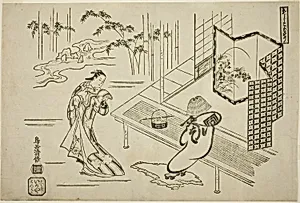
Two Actors in a Drama
About 1715
Medium
Woodblock print; sumizuri-e, ōban
Dimensions
28.8 × 42.6 cm (11 5/16 × 16 3/4 in.)
Classification
Department
Arts of Asia
Museum
Art Institute of Chicago
Accession Number
22946
Rights
Public Domain
About this artwork
The folds of the seated actor’s robe are suggested by characters meaning “role in disguise.”
Art Historical Context
**Two Actors in a Drama by Torii Kiyomasu I, created around 1715, captures the vibrant world of Edo-period kabuki theater through a striking woodblock print. As a master of the Torii school of the earliest ukiyo-e dynasties specializing in actor portraits (yakusha-e)—Kiyomasu I immortalized the dramatic poses and expressive faces of performers, turning stage stars into cultural icons. This sumizuri-e, or monochrome ink print in the large ōban format (28.8 × 42.6 cm), exemplifies the bold, theatrical style that defined early 18th-century Japanese printmaking, bridging traditional ink painting with the emerging "pictures of the floating world." The sumizuri-e technique, using only black ink and subtle gray tones from skillful printing, highlights Kiyomasu's mastery of line work and shading to convey movement and emotion without color. Produced during the Kyōhō era, when kabuki flourished in urban Japan, such prints were affordable souvenirs for theatergoers, democratizing access to celebrity culture. Housed in the Art Institute of Chicago's Arts of Asia collection, this piece reflects ukiyo-e's role in preserving ephemeral performances, offering a window into the lively entertainment hubs of old Tokyo. Fun fact: The Torii school's legacy paved the way for later geniuses like Hiroshige and Utamaro, evolving from these stark inks to multicolored masterpieces.
About the Artist
Torii Kiyomasu I · 1696–1716
Torii Kiyomasu I was a Japanese ukiyo-e artist working in the early eighteenth century, closely associated with the Torii school, one of the most important lineages in the history of Japanese woodblock printmaking. The Torii school was founded by Torii Kiyonobu, and Kiyomasu I is believed to have been either his son or a close pupil — the precise family relationship remains a matter of scholarly d...