
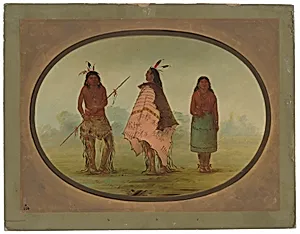
Two Apachee Warriors and a Woman
1855/1869
Medium
oil on card mounted on paperboard
Dimensions
overall: 46.7 x 62.2 cm (18 3/8 x 24 1/2 in.)
Classification
Painting
Department
CAB
Museum
National Gallery of Art, Washington, D.C.
Credit
Paul Mellon Collection
Accession Number
1965.16.147
Rights
Public Domain
Art Historical Context
George Catlin's *Two Apachee Warriors and Woman* (1855/1869) captures a poignant moment in Native American life during the turbulent mid-19th century. Catlin, a pioneering American and ethnographer, devoted his career to documenting Indigenous peoples of the Great Plains and Southwest before their cultures were profoundly altered by westward expansion. Traveling among tribes in the 183s, he amassed over 600 portraits and scenes, now celebrated as invaluable records of a vanishing world. This painting, from the Paul Mellon Collection at the National Gallery of Art, likely draws from Catlin's later European studio work, where he recreated memories from his American expeditions. Rendered in oil on card mounted on paperboard—a portable medium suited to Catlin's fieldwork sketches—the 46.7 x 62.2 cm work exemplifies his Romantic style. Vibrant colors and direct gazes emphasize the subjects' dignity and individuality, hallmarks of Catlin's ethnographic approach. The Apache figures, from the arid Southwest, embody resilience amid U.S. territorial conflicts, highlighting themes of cultural encounter and preservation. This piece underscores Catlin's urgent mission: to create an "Indian Gallery" as a bulwark against oblivion. For visitors, it offers a window into Apache traditions while inviting reflection on America's complex frontier history.
About the Artist
George Catlin · 1796–1872
George Catlin (1796–1872), born in Wilkes-Barre, Pennsylvania, to Putnam Catlin and Polly Sutton—who had been captured by Native Americans during the 1778 Battle of Wyoming—initially pursued a legal career. Trained at Litchfield Law School, he was admitted to the bar in 1819 but abandoned law after two years to study art in Philadelphia in 1823. Self-taught as a portraitist, Catlin quickly gained ...