
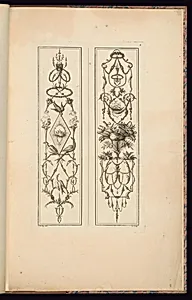
Two Arabesque Panel Designs
late 18th century
Medium
Classification
Department
Smithsonian Collection
Museum
Smithsonian American Art Museum
Credit
Purchased for the Museum by the Advisory Council
Accession Number
1921-6-308-9
Rights
Public Domain
About this artwork
Research in Progress
Art Historical Context
**Two Arabesque Panel Designs** by Jean-Baptiste captures the elegant flourish of late 18th-century French arts. Active from around 1765 through the 1790s, Fay was a skilled printmaker whose works served as blueprints for artisans crafting wall panels, furniture, and furnishings. Created in the final decades before the French Revolution, these designs reflect the opulent Rococo-to-Neoclassical transition, arabesques—intricate, flowing motifs of vines, scrolls, and foliage—adorned the interiors of chateaus and grand salons, symbolizing nature's graceful abundance. As a print, this artwork exemplifies the era's innovative reproductive techniques, allowing intricate patterns to be widely disseminated to workshops across Europe. Etching or engraving would have enabled precise replication, bridging fine art and craft. Fay's panels highlight how such designs democratized luxury, influencing everything from wallpaper to silverwork. Housed in the Smithsonian American Art Museum's print collection—purchased by the Advisory Council—this piece underscores transatlantic exchanges in design history. Though research continues, it invites visitors to appreciate the artistry behind everyday elegance, evoking the refined world of ancien régime France. (198 words)