
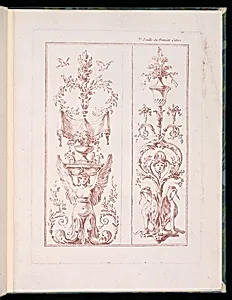
Two Arabesque Panel Designs
Medium
Classification
Department
Smithsonian Collection
Museum
Smithsonian American Art Museum
Credit
Purchased for the Museum by the Advisory Council
Accession Number
1921-6-481-3
Rights
Public Domain
About this artwork
Research in Progress
Art Historical Context
Jean-Baptiste Huet, a prominent French artist of the late Rococo era (1745–1810), created *Two Arabesque Panel Designs* between 1776 and 1789. This print captures the elegant, swirling motifs typical of arabesques—intricate, vine-like patterns inspired by antiquity and Islamic ornamentation, which flourished in 18th-century French decorative arts. Huet, celebrated for his lively depictions of animals and pastoral scenes, often blended whimsy with refinement, designing for luxury goods like tapestries, porcelain, and wallpapers produced at royal manufactories such as Gobelins and Beauvais. As a print, this work served a practical purpose: disseminating ornamental designs to artisans and decorators across Europe and beyond. During the Ancien Régime's final decades, such panels adorned opulent interiors, symbolizing taste and sophistication amid the shift toward Neoclassicism. Its presence in the Smithsonian American Art Museum, acquired through the Advisory Council, highlights transatlantic exchange, as French styles influenced early American decorative tastes. Though research continues, these designs exemplify Huet's mastery in evoking nature's fluidity, inviting visitors to imagine them gracing gilded salons. A delightful glimpse into Enlightenment-era elegance! (198 words)