
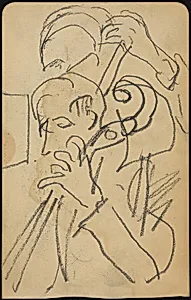
Two Bass Players
1918
Medium
graphite on wove paper
Dimensions
overall: 17.4 x 11 cm (6 7/8 x 4 5/16 in.)
Classification
Drawing
Department
CG-W
Museum
National Gallery of Art, Washington, D.C.
Credit
Given in memory of Frederick Zimmermann by his wife, Dorothy Zimmermann
Accession Number
1985.18.39
Rights
Public Domain
Art Historical Context
**Two Bass Players**, a delicate graphite drawing on wove paper by Maxmann from 1918, invites visitors into an intimate snapshot of two musicians at work. Measuring just 17.4 x 11 cm, this compact work (6 7/8 x 4 5/16 in.) showcases the artist's masterful use of graphite to render form and texture with precise, expressive lines. Now housed in the National Gallery of Art's CG-W Department, it was generously given in memory of Frederick Zimmermann by his wife, Dorothy. Created at the close of World War I, the drawing reflects Beckmann's emergence as a leading German Expressionist. Deeply affected by his wartime service—which led to a nervous breakdown—he channeled raw emotion and distorted realities into his art, moving away from traditional realism toward bold, psychological intensity. Though best known for his large triptychs and oils, Beckmann's drawings like this one served as vital studies, capturing everyday subjects with a haunting immediacy. Graphite on wove paper, a smooth and versatile support, allowed Beckmann to build subtle tonal contrasts, emphasizing the bass players' focused postures and instruments. This piece highlights his fascination with performers, blending cultural motifs of music with the era's turbulent spirit, offering a poignant glimpse into early 20th-century artistic innovation.
About the Artist
Max Beckmann · 1884–1950
Max Carl Friedrich Beckmann (1884-1950) stands as one of the most significant German painters of the twentieth century, a complex artist who bridged Expressionism and the New Objectivity while forging a deeply personal visual language. Born in Leipzig into a middle-class family, Beckmann's artistic journey spanned from academic classicism through the traumatic crucible of World War I to a mature s...