
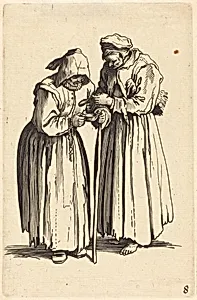
Two Beggar Women
1622 or later
Medium
etching on laid paper
Dimensions
sheet (trimmed to plate mark): 14 × 9.3 cm (5 1/2 × 3 11/16 in.)
Classification
Department
CG-E
Museum
National Gallery of Art, Washington, D.C.
Credit
Rosenwald Collection
Accession Number
1949.5.313
Rights
Public Domain
Art Historical Context
"Two Beggar Women," an etching after the renowned French artist Jacques Callot, dates to 1622 or later and the poignant lives of society's marginalized in the early 17th century.ot, a master printmaker of the Baroque era, was famous for his empathetic depictions of the poor and itinerant, as seen in his influential series *Les Gueux* (The Beggars). This-scale work (14 × 9.3 cm), trimmed to the plate mark on laid paper, echoes his style, likely produced as a reproduction to disseminate his vivid social commentary during a time of economic hardship and the Thirty Years' War. Etching, Callot's preferred medium, allowed for intricate lines and textures that convey the beggars' ragged clothing, expressive faces, and weary postures with remarkable precision. The technique involved coating a copper plate with acid-resistant ground, scratching designs into it, and immersing it in acid to etch fine details—revolutionizing printmaking with its speed and subtlety compared to engraving. Housed in the National Gallery of Art's Rosenwald Collection (Department CG-E), this print highlights Callot's legacy in documenting human suffering, blending artistry with subtle critique of inequality. Visitors will appreciate how such intimate works humanized the overlooked, influencing later artists like Goya and offering a window into 17th-century Europe's underbelly.
About the Artist
after Jacques Callot
**Jacques Callot (c. 1592–1635)**, the master whose designs inspired the works attributed "after Jacques Callot," was a pioneering French Baroque printmaker and draftsman born in Nancy, capital of the independent Duchy of Lorraine (now northeastern France). From a noble family—his father served as master of ceremonies and herald-at-arms to the Duke of Lorraine—young Callot was apprenticed to a gol...