
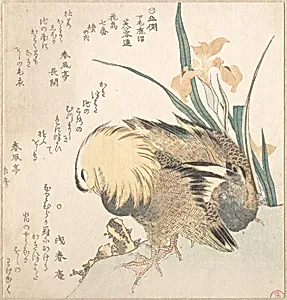
Pair of Mandarin Ducks and Iris Flowers
Medium
Woodblock print (surimono); ink and color on paper
Dimensions
7 5/8 x 6 3/4 in. (19.4 x 17.1 cm)
Classification
Prints
Culture & Period
Japan · Edo period (1615–1868)
Department
Asian Art
Museum
Metropolitan Museum of Art, New York, NY
Credit
H. O. Havemeyer Collection, Bequest of Mrs. H. O. Havemeyer, 1929
Accession Number
JP2181
Rights
Public Domain
Tags
Art Historical Context
In the serene world of Edo-period Japan (1615–1868), Kubo Shunman's *Pair of Mandarin Ducks and Flowers* captures nature's poetic harmony through the delicate art of surimono—a luxurious woodblock print commissioned for private occasions like New Year's greetings or poetry gatherings. Created with ink and vibrant color on paper, this intimate 7 5/8 x 6 3/4 in. gem showcases Shunman's mastery as a ukiyo-e and poet, blending precise carving techniques with subtle gradients (bokashi) for lifelike feathers and petals. Mandarin ducks, depicted as a devoted pair, hold deep cultural symbolism in Japanese lore as emblems of fidelity and marital bliss, often gifted to celebrate unions. The elegant iris flowers, blooming alongside, evoke seasonal beauty and resilience, their sword-like leaves nodding to samurai heritage. Shunman's refined composition reflects surimono's exclusivity—printed in small editions with mica or embossing for tactile allure—elevating everyday motifs into treasures of wit and elegance. Housed in the Metropolitan Museum of Art's H. O. Havemeyer Collection, this print invites visitors to ponder the Edo era's blend of artistry and auspicious wishes, where a simple pond scene whispers enduring love.
About the Artist
Kubo Shunman · 1757–1820
Japanese, 1757–1820