
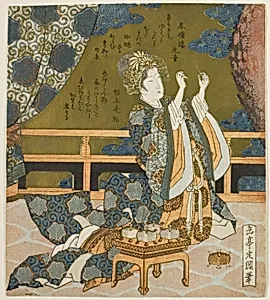
Two Chinese Women Examining Thread and a Spider’s Web in a Box, from the series "Diptych for the Drum Group"
c. 1824
Medium
Color woodblock prints with metallic pigment; surimono shikishiban diptych
Dimensions
21.3 × 19 cm (8 7/16 × 7 1/2 in.)
Classification
woodblock print
Department
Arts of Asia
Museum
Art Institute of Chicago
Accession Number
80975
Rights
Public Domain
Art Historical Context
In the early 19th century, Japan's Edo period, artist Yashima Gakutei crafted this exquisite diptych titled *Two Chinese Women Examining Thread and a’s Web in a Box from the series "Dych for the Drum Group (c. 1824). A master of surimono—luxurious, privately commissioned woodblock prints often produced for New Year's greetings or poetry circles—Gakutei employed woodblock printing with shimmering metallic pigments on shikishiban (square) sheets, measuring just 21. × 19 cm. This intimate format, housed in the Art Institute of Chicago's Arts of Asia collection, highlights the refined artistry of ukiyo-e's more elite branch. The delicate scene captures two elegant Chinese women intently peering into a box containing fine thread and a spider’s web, evoking themes of intricacy, patience, and perhaps subtle symbolism from folklore or poetry. Gakutei's precise lines and subtle gradations, enhanced by mica or gold pigments, create a luminous, jewel-like quality that draws the viewer into their quiet curiosity. Such details showcase his skill in bijin-ga (images of beautiful women), blending realism with poetic elegance. As part of a series likely commissioned by a drum or poetry group, this print reflects surimono's cultural role in fostering artistic patronage among literati. It exemplifies how woodblock prints transcended mass production to become treasured keepsakes, preserving ephemeral moments of beauty and intellectual play in Japan's vibrant print culture.
About the Artist
Yashima Gakutei · 1786–1868
Yashima Gakutei (c. 1786–1868), born in Osaka as the illegitimate son of a Tokugawa shogunate samurai named Hirata, adopted the name from his mother's subsequent marriage into the Yashima clan. Little is documented about his early years beyond these familial ties, but he pursued artistic training under the esteemed ukiyo-e masters Totoya Hokkei and Katsushika Hokusai, absorbing their precision in ...