
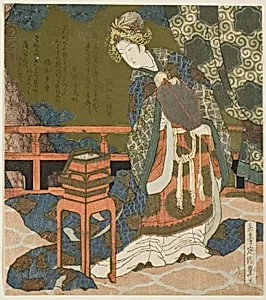
Two Chinese Women Examining Thread and a Spider’s Web in a Box, from the series "Diptych for the Drum Group"
c. 1824
Medium
Color woodblock prints with metallic pigment; surimono shikishiban diptych
Dimensions
20.6 × 18.4 cm (8 1/8 × 7 1/4 in.)
Classification
woodblock print
Department
Arts of Asia
Museum
Art Institute of Chicago
Accession Number
80977
Rights
Public Domain
Art Historical Context
In the early 19th century, artist Yashima Gaki crafted this enchanting diptych, *Two Chinese Women Examining Thread a Spider’s Web in a Box*, from the series *Diptych for the Drum Group* (c. 1824). Printed on delicate shikishiban paper—a square format favored for intimate viewing—the work measures just 20.6 × 18.4 cm. Using color woodblock techniques with shimmering metallic pigments, Gaki captured a serene moment of curiosity, where two elegant Chinese women peer into a box holding fine thread and a spider’s web. These luxurious *surimono* prints, often commissioned by poetry circles or enthusiast groups like the "Drum Group," were private treasures, not mass-produced for sale. Gakutei, a master of the ukiyo-e tradition, excelled in precise lines and subtle colors, blending realism with poetic whimsy. The metallic accents—gold or silver flecks—enhance the web’s intricate glow, evoking themes of fragility and artistry in nature. Surimono like this celebrated elite tastes, frequently incorporating haiku or New Year’s greetings, though here the focus is on the visual riddle of silk and silk-like spider silk. Housed in the Art Institute of Chicago’s Arts of Asia department, this piece highlights Japan’s Edo-period printmaking pinnacle, where everyday wonder met technical innovation, inviting viewers to ponder the delicate interplay of human craft and natural marvel.
About the Artist
Yashima Gakutei · 1786–1868
Yashima Gakutei (c. 1786–1868), born in Osaka as the illegitimate son of a Tokugawa shogunate samurai named Hirata, adopted the name from his mother's subsequent marriage into the Yashima clan. Little is documented about his early years beyond these familial ties, but he pursued artistic training under the esteemed ukiyo-e masters Totoya Hokkei and Katsushika Hokusai, absorbing their precision in ...