
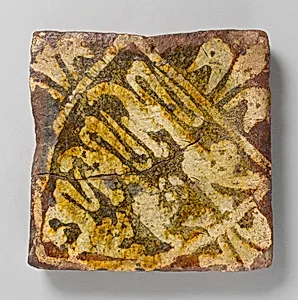
Two-Colored Tile with arms of England
Unknown Artist
14th or 15th century
Medium
Fired earthenware, with slip decoration and lead glaze
Dimensions
Overall: 5 1/4 x 5 1/4 in. (13.3 x 13.3 cm)
Classification
Ceramics-Tiles
Culture
British
Department
The Cloisters
Museum
Metropolitan Museum of Art, New York, NY
Credit
The Cloisters Collection, 1983
Accession Number
1983.236.6
Rights
Public Domain
Art Historical Context
This charming two-colored tile, featuring the arms of England,ails from 14th- or 15th-century Britain, a time when heraldry blossomed as a visual language of power and identity. Crafted by an unknown artisan, it showcases the royal emblem—likely the iconic three lions—boldly rendered in a vivid contrast of hues, evoking the grandeur of medieval courts, churches, and noble halls. Measuring a modest 5¼ x 5¼ inches, such tiles were often mass-produced for flooring or wall panels, transforming everyday spaces into statements of allegiance and prestige. The tile's medium—fired earthenware with slip decoration and lead glaze—highlights innovative medieval ceramics techniques. Slip, a creamy suspension of clay, was trailed or painted onto the unfired surface to create the two-tone design, then sealed with a shiny lead glaze for durability and luster before firing. This method allowed affordable, colorful production, making heraldic motifs accessible beyond elite tapestries or stone carvings. Housed in The Cloisters at the Metropolitan Museum of Art (The Cloisters Collection, 1983), this artifact offers a tangible glimpse into British cultural life, where tiles like this adorned sacred and secular sites, blending artistry with symbolism. It's a humble yet eloquent survivor of the Middle Ages, inviting us to ponder the footsteps that once trod upon it.