
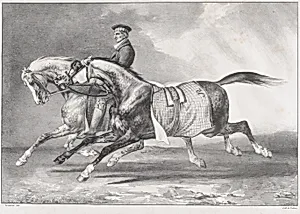
Two Dappled-Grey Horses Being Exercised
Medium
Lithograph
Dimensions
sheet: 16 13/16 x 22 7/8 in. (42.7 x 58.1 cm) plate: 11 3/16 x 16 9/16 in. (28.4 x 42 cm)
Classification
Prints
Department
Drawings and Prints
Museum
Metropolitan Museum of Art, New York, NY
Credit
Rogers Fund, 1920
Accession Number
20.17.7
Rights
Public Domain
Tags
Art Historical Context
Step into the dynamic world of Théodore Gault's *Two Dappled-Grey Horses Being Exercised* (1822), a captivating lithograph from the Metropolitan Museum of Art's Drawings and Prints collection. late in the artist's short life—he died at 32—this print captures two sleek, dappled-grey horses in spirited motion, guided by attentive handlers. Géricault, a leading French Romantic artist famed for dramatic works like *The Raft of the Medusa* (1819), had a lifelong passion for horses, viewing them as symbols of raw power and vitality. This piece belongs to his innovative series of horse lithographs from around 1820–22, reflecting the era's fascination with equestrian culture amid France's post-Napoleonic recovery. Lithography, a revolutionary printmaking technique invented just decades earlier, allowed Géricault to draw directly on stone with greasy crayon, producing rich, fluid lines that convey the horses' muscular energy and subtle coat textures. Measuring about 11 x 16 inches on the plate, the work's intimate scale belies its intensity, making multiple impressions possible for wider audiences. As one of the medium's early masters, Géricault elevated lithography from commercial tool to fine art, blending precise anatomy studies—drawn from live models—with Romantic expressiveness. Today, acquired via the Rogers Fund in 1920, this print offers a window into 19th-century equine life and Géricault's genius for motion. It's a testament to how everyday scenes could pulse with drama, inviting visitors to feel the horses' restrained power.
About the Artist
Théodore Gericault · 1791–1824
Théodore Géricault, born Jean-Louis André Théodore Géricault on September 26, 1791, in Rouen, France, into a prosperous family—his father a lawyer turned tobacco merchant and his mother from a line of growers—moved to Paris around 1797. Displaying early artistic promise, recognized by painter Jean-Louis Laneuville, he began formal training in 1808 under Carle Vernet, mastering English sporting art...