
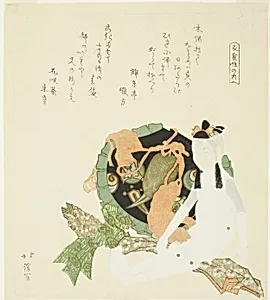
Two dolls and a brocade bag, from the series "Clothing, Food, and Shelter (Ishokuju no uchi)"
1818
Medium
Color woodblock print; shikishiban, surimono
Dimensions
20.8 × 18.5 cm (8 1/4 × 7 5/16 in.)
Classification
woodblock print
Department
Arts of Asia
Museum
Art Institute of Chicago
Accession Number
81081
Rights
Public Domain
Art Historical Context
In the vibrant world of Edo-period Japan (1603–1868), Totoya Hokkei's *Two Dolls and a Brocade* from the series *Clothing Food, and Shelter (okuju no uchi)* captures everyday luxuries with whimsical charm. Created in 1818, this color woodblock print reflects the ukiyo-e tradition of depicting floating-world pleasures, playfully nodding to life's essentials—clothing, food, and shelter—through intimate domestic scenes. Hokkei, a pupil of the famed Katsushika Hokusai, was renowned for his delicate, poetic compositions that elevated ordinary objects into art. Printed in the luxurious *surimono* format—a privately commissioned style often produced for New Year's greetings or poetry clubs—this shikishiban (square) sheet measures a compact 20.8 × 18.5 cm, ideal for albums or gifts. The technique involved multiple woodblocks for vivid colors, subtle gradations (*bokashi*), and sometimes metallic pigments or embossing, showcasing the pinnacle of Japanese printmaking craftsmanship. The brocade bag and dolls evoke childhood innocence and textile artistry, symbols of refined taste amid urban Japan's bustling merchant culture. Housed in the Art Institute of Chicago's Arts of Asia department, this print highlights surimono's cultural role as ephemeral treasures, blending art, literature, and social exchange. Visitors will delight in its intimate scale and timeless appeal, a window into 19th-century Japan's elegant simplicity.
About the Artist
Totoya Hokkei · 1780–1850
Totoya Hokkei (魚屋 北渓, 1780–1850), born Iwakubo Tatsuyuki in Edo (modern Tokyo), began his life as a humble fishmonger in the Yotsuya Samegahashi district, a trade reflected in his art name "Totoya," meaning fish shop. He transitioned to art through rigorous training, first studying under Kanō Yōsen'in Korenobu, head of the Kobikichō branch of the prestigious Kanō school, where he honed landscape p...