
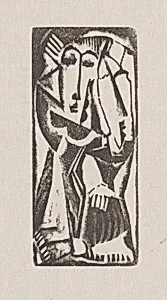
Two Figures
1919-1920
Medium
woodcut in black on laid paper
Dimensions
image: 10.64 × 4.76 cm (4 3/16 × 1 7/8 in.) sheet: 24.61 × 16.03 cm (9 11/16 × 6 5/16 in.)
Classification
Department
CG-W
Museum
National Gallery of Art, Washington, D.C.
Credit
Gift of Jack and Margrit Vanderryn
Accession Number
2015.114.5
Rights
Public Domain
Art Historical Context
**Two Figures** (1919-1920) by Max Weber is a striking woodcut print, rendered in bold black ink on laid paper. Measuring just 10.64 × 4.76 cm for the image itself, this intimate work invites close viewing, its compact scale contrasting with the larger sheet (24.61 × 16.03 cm). Housed in the National Gallery of Art's Prints department, it exemplifies Weber's exploration of modernist printmaking during a pivotal post-World War I era. Weber, a Russian-born American artist (1881–1961), was a key figure in early 20th-century modernism, blending Cubist fragmentation with influences from African sculpture and Cézanne. Here, the woodcut medium—carved from wood blocks and printed under pressure—produces crisp, graphic lines and high contrast, ideal for distilling human forms into abstracted, angular silhouettes. The "two figures" evoke a sense of dynamic tension, their intertwined poses suggesting intimacy or confrontation amid the era's social upheavals. This rare print highlights Weber's shift toward printmaking, a democratic medium that made avant-garde art accessible. Its simplicity belies technical mastery, as the laid paper's textured surface enhances the woodcut's tactile depth, bridging traditional craftsmanship with radical abstraction. A gem for visitors, it captures the revolutionary spirit of American modernism.
About the Artist
Max Weber · 1881–1961
Max Weber (1881–1961), born in Białystok in the Russian Empire (now Poland) to Orthodox Jewish parents, immigrated to Brooklyn, New York, at age ten with his family, joining his tailor father.) There, he pursued art studies at the Pratt Institute under Arthur Wesley Dow, an innovative teacher who emphasized expression and form over traditional narrative, drawing from Japanese art and Paul Gauguin....