
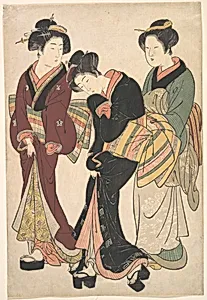
Two Geishas and a Maid
ca. 1790
Medium
Woodblock print; ink and color on paper
Dimensions
15 x 10 1/8 in. (38.1 x 25.7 cm)
Classification
Prints
Culture & Period
Japan · Edo period (1615–1868)
Department
Asian Art
Museum
Metropolitan Museum of Art, New York, NY
Credit
The Howard Mansfield Collection, Purchase, Rogers Fund, 1936
Accession Number
JP2656
Rights
Public Domain
Tags
Art Historical Context
In the vibrant world of Edo Japan (1615–1868), Kitao Shigem's *Two Geishas and a Maid* (ca. 1790) captures the elegance of the "floating world" (ukiyo-e), a cultural sphere of entertainment districts like Yoshiwara in Edo (modern Tokyo). Shigemasa, a masterkiyo-e printmaker and illustrator trained under Suzuki Harunobu specialized in bijin-ga—depictions of beautiful women—blending delicate realism with stylized grace. This woodblock print, rendered in ink and vibrant colors on paper, exemplifies the medium's revolutionary role: affordable multiples made sophisticated art accessible beyond the elite, fueling a booming urban print culture. The composition features two poised geishas, symbols of refined artistry in music, dance, and conversation, attended by a humble maid, highlighting social hierarchies in Japan's pleasure quarters. Subtle details—like flowing kimonos, ornate hairpins, and expressive faces—showcase Shigemasa's skill in multi-block printing, where carvers and printers layered colors for depth and luminosity. Measuring just 15 x 10 inches, it invites intimate viewing, evoking the transient beauty prized in ukiyo-e. From The Howard Mansfield Collection at The Metropolitan Museum of Art, this print offers a window into 18th-century Japanese femininity, leisure, and craftsmanship, reminding us how everyday scenes became timeless icons.
About the Artist
Kitao Shigemasa · 1739–1820
Kitao Shigemasa (1739–1820), born in the bustling Nihonbashi district of Edo (modern Tokyo), emerged as a pivotal figure in ukiyo-e woodblock printing during Japan's Edo period. The eldest son of the bookseller Suharaya Mohei—from a lineage of publishers—Shigemasa, originally named Kitabatake Tarōkichi, was immersed in the world of printing from youth. Largely self-taught, he later studied under t...