
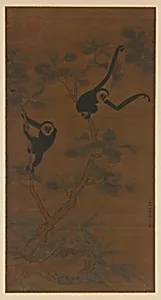
Two Gibbons in a Tree
15th century
Classification
Painting
Department
Smithsonian Collection
Museum
Smithsonian American Art Museum
Credit
Gift of Charles Lang Freer
Accession Number
F1911.272
Rights
Public Domain
Tags
About this artwork
To 1911
Art Historical Context
Behold *Two Gibbons in a Tree*, a captivating 15th-century painting attributed to Yi Yuanji a master artist active in the mid- to late 11th century during Northern Song dynasty. Though created in the Ming dynasty (1368–1644), this work reflects Yi's renowned specialty in depicting gibbons—playful, agile primates that he portrayed with lifelike grace and expressiveness. Gibbons held cultural allure in Chinese art, symbol harmony with nature and poetic freedom, often shown amid lush foliage to evoke the wild beauty of the natural world. As a fine example of Chinese painting traditions, the artwork likely employs delicate ink washes and precise brushwork on silk or paper (medium unspecified), hallmarks of the literati style that prized spontaneity and observation from life. Yi Yuanji's gibbon paintings were so celebrated that later artists emulated them, preserving his legacy through Ming-era copies that bridged Song innovation with imperial refinement. Acquired by collector Charles Lang Freer before 1911, this piece entered the Smithsonian American Art Museum as a gift, joining treasures in the Freer collection. It invites visitors to ponder the enduring cross-cultural fascination with China's artistic mastery of the animal kingdom.