
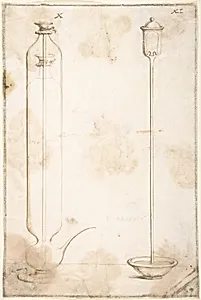
Two Glass Containers for Scientific Experiments with Liquids (Illustrations for "Saggi di naturali esperienze")
Medium
Black chalk, pen and brown ink, brush and brown and gray wash, black chalk framing lines
Dimensions
sheet: 11 1/16 x 7 3/8 in. (28.1 x 18.7 cm)
Classification
Drawings|Ornament & Architecture
Department
Drawings and Prints
Museum
Metropolitan Museum of Art, New York, NY
Credit
The Elisha Whittelsey Collection, The Elisha Whittelsey Fund, 1952
Accession Number
52.570.218
Rights
Public Domain
Tags
Art Historical Context
Step into the dawn of modern science with this intriguing 17th-century drawing *Two Glass Containers for Scientific with Liquids*, created anonymously in 1666 as an illustration for *Saggi di naturali esperienze ("Essays on Natural Experiments a seminal Italian text exploring natural philosophy through hands-on trials. Amid the Scientific Revolution, when figures like Galileo and Boyle were pioneering empirical methods, these precise depictions of laboratory glassware—likely used for observing liquid behaviors—captured the era's fascination with controlled experimentation. Housed in the Metropolitan Museum of Art's Drawings and Prints department, the sheet measures a modest 11 1/16 x 7 3/8 inches, yet it bridges art and discovery with remarkable clarity. The artist employed a sophisticated mixed-media technique: black chalk for initial framing and subtle shading, pen and brown ink for crisp outlines, and brush with brown and gray wash to evoke the translucent sheen of glass and the play of light on liquids. This combination allowed for meticulous detail, essential for scientific accuracy, while hinting at the ornamental precision often seen in period architecture and design illustrations. These works underscore the vital, often unsung role of anonymous draftsmen in visualizing emerging knowledge, transforming abstract experiments into tangible records. A window into 1660s Italy's intellectual fervor, it reminds us how art fueled the Scientific Revolution's quest to unravel nature's secrets.
About the Artist
Anonymous, 17th century · 1600–1700
**Anonymous, 17th century** remains one of the most intriguing figures—or rather, non-figures—in art history, representing the countless unnamed painters, draftsmen, and sculptors whose works survive from the Baroque era. Active across Europe between 1600 and 1700, this designation encompasses artists whose identities have been lost to time, yet whose output forms a substantial part of museum coll...